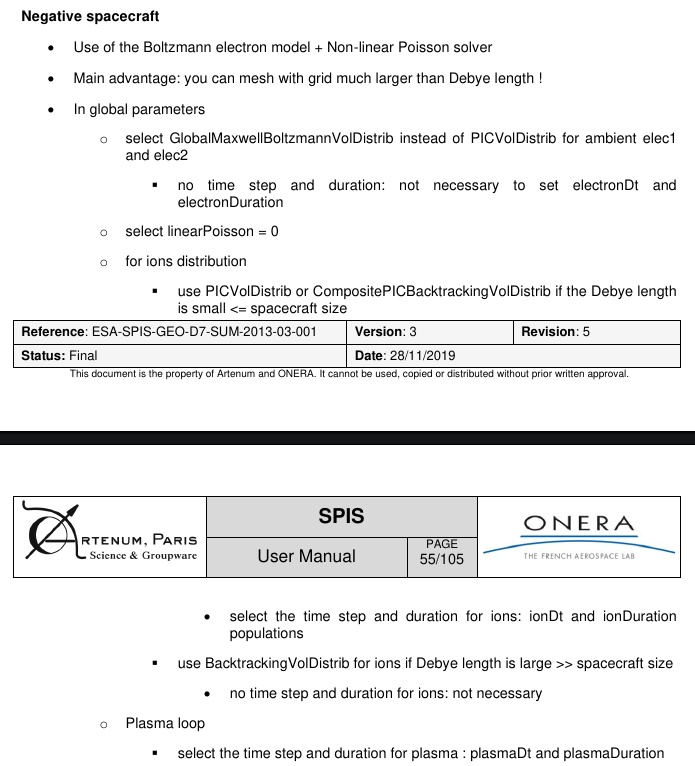
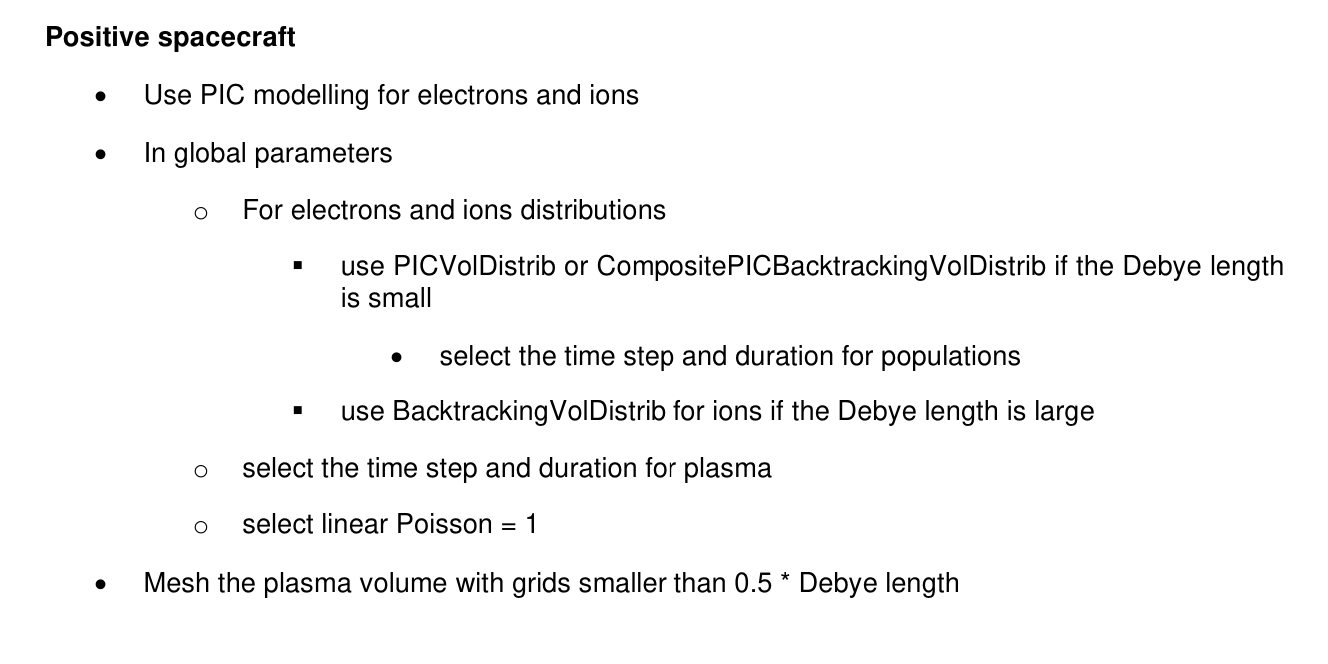
In one of the SPIS documents, specifically ESA-SPIS-GEO-D7-SUM-2013-03-001 ver 3 rev 5, It lays out some basic parameters to input for when you have a positive or negative potential.
Some documents seem to have older info, so I want to know if these parameters are still accurate? Would these change in different scenarios? I’m conducting some simulations in plasma sphere conditions (high density, low temp) as an example. Using SPIS 6.2.6
Since you don’t list them it’s not easy to answer but in general they still apply. Some limitations may have been no longer true, like KineticMaxwellBoltzmannVolDistrib allows us to simulate electrons also if the spacecraft potential is positive
My apologies, for some reason when I made this post it wouldn’t allow me to upload photos. Here are the parameters in question. I guess my main questions are the following:
When is it best to use the GlobalMaxwellBoltzmann/PIC distributions for electrons and ions?
What constitutes a small debye length? Is this compared to the size of the model’s mesh?
the manual gives some advice, and it’s not wrong. It makes the distinction when you expect to have negative or positive charging in your volume, (and assumes it’s the spacecraft that charges positive or negatively)
On Debye length, the manual is actually clear. Debye length is small if it’s less or equal to the spacecraft size (not the mesh).
ions should never use any maxwell boltzmann approximation as it’s almost never the case that their relative flow speed is small compared to their thermal speed.
on when to use GlobalMaxwellBoltzmann, for electrons - I’d argue that there’s never a reason to use it now. KineticMaxwellBoltzmannVolDistrib is identical for GlobalMaxwellBoltzmannVolDistrib when there are only negative potentials (and thus negative spacecraft charging) and not bad for positive potentials (here GlobalMaxwellBoltzmannVolDistrib is completely unphyiscal) . PICVolDistrib is more correct for positive potentials. It’s also slower, and more sensitive to instabilities.